Originally published in the Watertown Daily Times, May 20, 2025 | Cover Photo by Alec Johnson/Watertown Daily Times
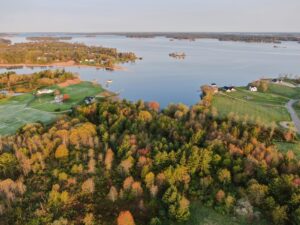
Blind Bay, which has been under threat of the federal government’s desire to build a massive border station on its banks, received some special attention Tuesday from the two Clayton organizations that have fought fiercely to keep it pristinely natural.
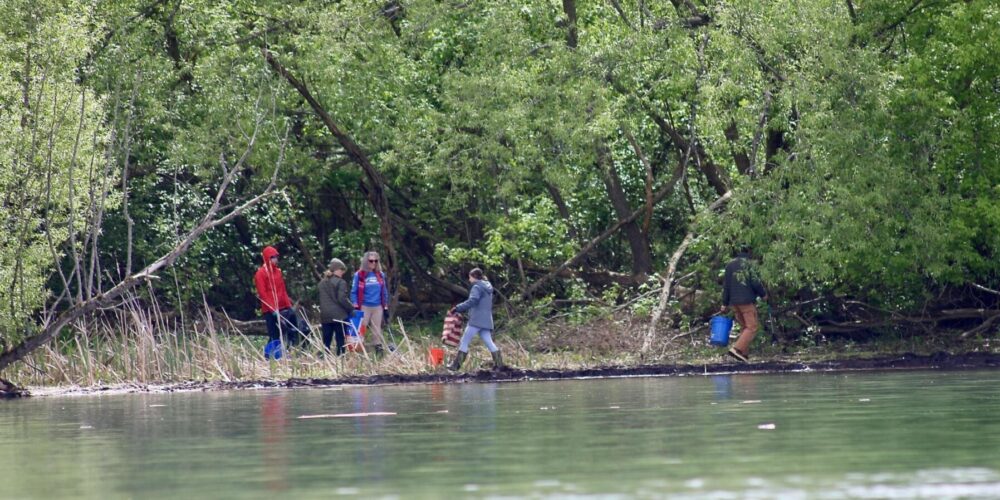
By mid-morning, staff and volunteers with Save the River and the Thousand Islands Land Trust — which owns most of the undeveloped land — had hauled piles of junk from the shoreline and shallow bay of the St. Lawrence River.
“You might find lawn furniture, pieces of dock, barrels, you never know,” said Bridget Wright, executive director of Save the River. And while from a distance one would not notice any necessary cleanup, it was no chore for the dozen or so people on shore and in kayaks to find trash to load into TILT’s boat to be hauled away.
In the first hour, they pulled out barrels, bumpers, and a pile of lumber, all junk that either fell or was discarded in the St. Lawrence River and dropped by waves and current onto the banks of Blind Bay since last spring, when there was more uncertainty about the Customs and Border Protection agency’s plans for a new building.
Customs and Border Protection has been working for years to plan a new Border Patrol station in the Thousand Islands region to replace the overcrowded station on Wellesley Island. The primary site for the 49,000-square-foot facility with docks, parking garages, kennels, and more was undeveloped land on Blind Bay. TILT worked with its donor base and immediately purchased the land to protect it from development, but the government proceeded to show interest in the property.
Protecting the property, which is in the town of Orleans, has been the focus of local, state, and federal officials, environmentalists and community residents. A secondary site at Dockside Cottages in Clayton was identified, but a publicly generated proposal to site the station near the Thousand Island Bridge was finally considered in November, though no decisions have been made.
On Tuesday, Wright pointed to the tree line that stretched over the shore as the trash-collecting volunteers crawled under limbs, pulling out the spoils of winter.
“It is a great day and it is a great community effort, just keeping it clean and keeping an eye on it,“ she said. ”This time of year is usually interesting because it could be whatever the currents brought in from the winter or last fall. There is always a lot of wind, rain, and snowstorms, so you never know what you will find.”
The shoreline is home to several species, making it an environmentally sensitive ecosystem, Wright said. “We have staff going through the back end, through the land side. It is a little bit of bushwhacking in there, and that is how we like it — it is very natural.”
“It is just such a beautiful, untouched, preserved spot on the river. You don’t see that often with the cycles of life that are losing their habitat. This, with your wetlands, is the perfect breeding ground for many fish and species.”
There are snakes, birds, frogs and several species of fish that coexist. “There is such a little community going on in there that you just wouldn’t notice,” she said. “This bay, in particular, is incredibly important to preserve and protect. It is one of the last shorelines in this area that has been undeveloped and untouched.”
The shallow water of the bay itself has been documented by the Thousand Islands Biological Station on Governors Island as a sensitive breeding ground for muskellunge, which long ago were nearly fished out of the river to extinction.
SUNY College of Environmental Science and Forestry students track the spawning of muskellunge and other fish that are caught in nets and then released.
On Tuesday, three students arrived in an old Boston Whaler shortly after the cleanup began and, unrelated to the organized effort, checked nets for fish.
“The biological station has been working here for 17, 18 years now, maybe more than that, where they are helping to keep the muskie population to continue to populate,” Wright said. “This is basically their nursery.”
The students, Thomas Desrameaux of New York City, Gretta Pesesky of Horseheads, and Matthew Norvilitis of Buffalo, idled slowly up to an Oneida net in the bay to check for fish. While Desrameaux piloted, Pesesky reached into the net, pulling it partially onto the boat so Norvilitis could catch the fish with a net. On Tuesday, two fish, a bass and a northern pike, were in the net.
Matthew Norvilitis of Buffalo releases fish caught in a trap used to survey muskellunge population in Blind Bay as Thomas Desrameaux of New York City takes notes and Gretta Pesesky of Horseheads looks on. All three are a SUNY College of Environmental Science & Forestry students stationed at Governors Island. Alec Johnson/ Watertown Daily Times
Desrameaux said they use the traps to capture muskie for their muskellunge survey. They take notes on the temperature, the dissolved oxygen, and all the fish species they catch in each net before releasing.
“We are mostly focused on the muskellunge, the chain pickerel, bass pickerel, and the northern pike,” he said. The bass, which are well-populated in the St. Lawrence and in Lake Ontario, were the first released while the northern pike was examined.
“We found a northern pike that was 876 millimeters and a female,” he said. But it was not producing any eggs.
After explaining their studies, the students motored off across the bay to check a second trap, a hoop net, that is positioned just past an outcropping of cattails.
Wright said the muskie complete their life cycle in bays like Blind Bay. “They go out, live their life, and when it is time to spawn, they come back here. That is their way of life, and if they come back to the place where they are born, and it is not there anymore, they don’t have anyplace to go. They are kind of lost without that.
And so, TILT and Save the River will continue to return to Blind Bay annually to remove evidence of humans so the ecosystem can thrive undisturbed.
“It is beautiful, it is this perfect little spot we are trying to keep healthy and protected,” Wright said before she and TILT Executive Director Jake Tibbles loaded piles of trash in the boat to be hauled away.